Enter a brief description of your changes
(Required)
Minor changes are by default collapsed in the page history.
No changes
The page does not exist yet.
Failed to load changes
Version by on
Leave Collaboration
Are you sure you want to leave the realtime collaboration and continue editing alone? The changes you save while editing alone will lead to merge conflicts with the changes auto-saved by the realtime editing session.
Distributed Commit With Bounded Waiting
Danny Dolev, H. Raymond Strong
IEEE Symposium on Reliability in Distributed Software and Database Systems (SRDS 1982), pages 53–60
IEEE Computer Society
July 1982
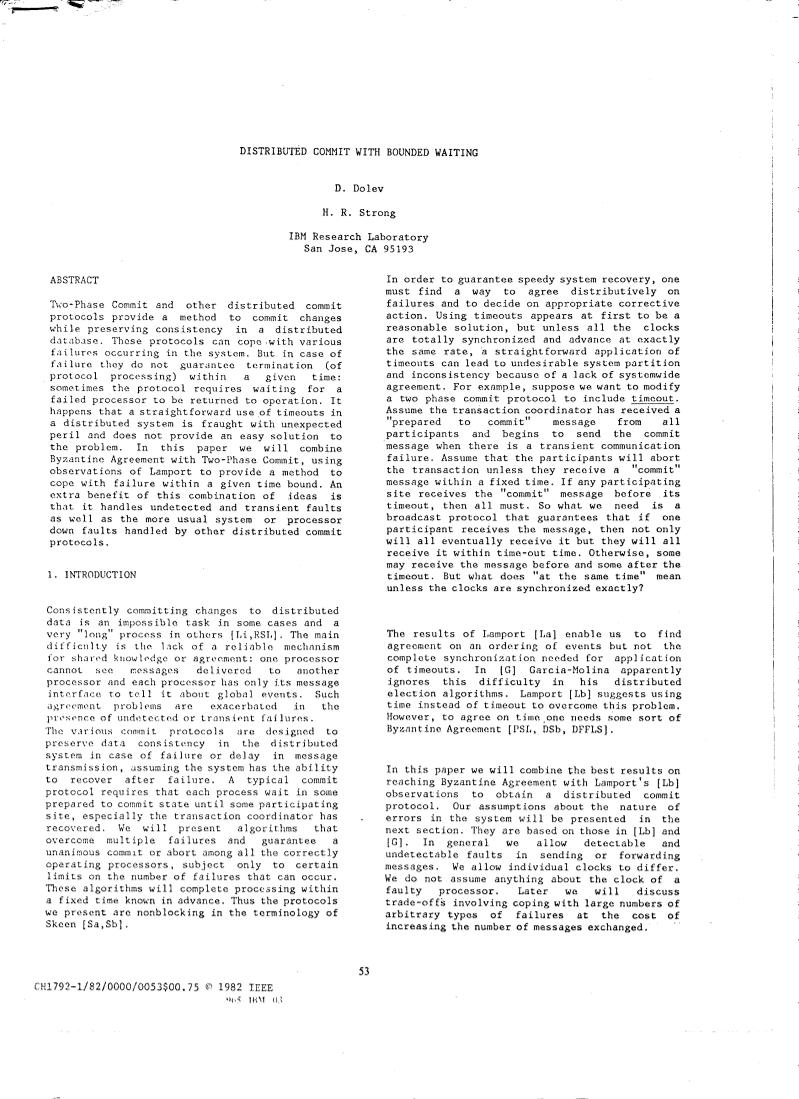
Two-Phase Commit and other distributed commit protocols provide a method to commit changes while preserving consistency in a distributed database. These protocols can cope with various failures occurring in the system. But in case of failure they do not guarantee termination (of protocol processing) within a given time: sometimes the protocol requires waiting for a failed processor to be returned to operation. It happens that a straightforward use of timeouts in a distributed system is fraught with unexpected peril and does not provide an easy solution to the problem. Byzantine Agreement is combined with Two-Phase Commit, using observations of Lamport to provide a method to cope with failure within a given time bound. An extra benefit of this combination of ideas is that it handles undetected and transient faults as well as the more usual system or processor down faults handled by other distributed commit protocols.